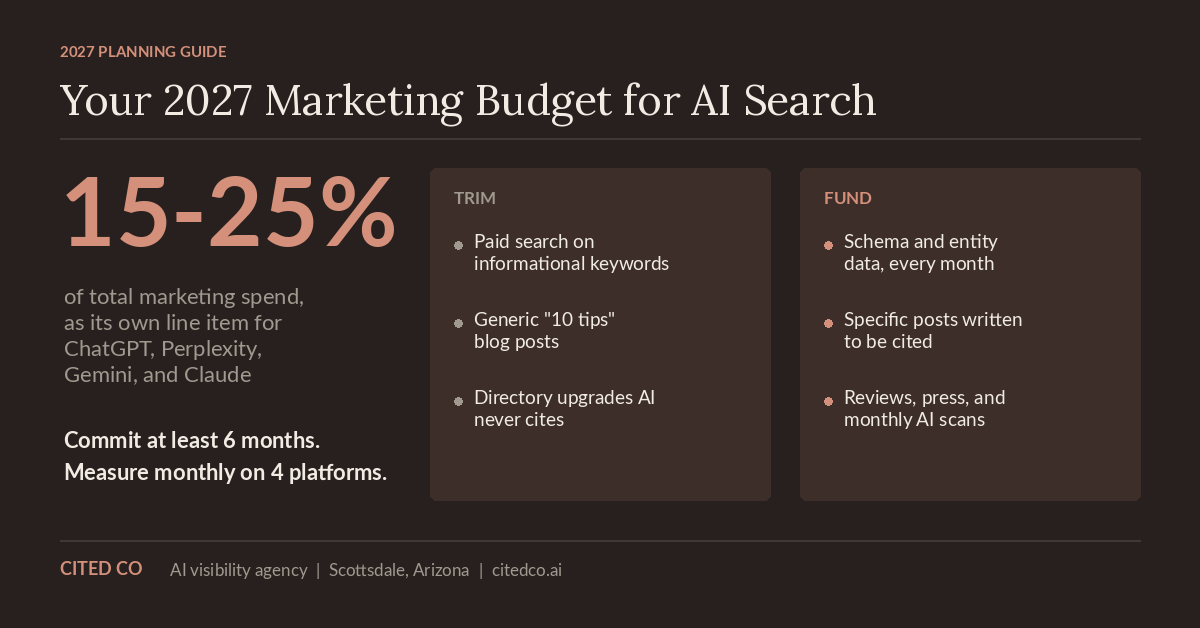
When owners ask me how to plan a 2027 marketing budget, AI search is now the first line we talk about, and my answer is the same almost every time. Give ChatGPT, Perplexity, Gemini, and Claude their own line item next year. For most service businesses, size it at roughly 15 to 25 percent of total marketing spend. Fund it mainly by trimming paid search on informational keywords and generic content that AI answers have already replaced. Before you move a dollar, measure where you stand today, and commit to at least six months so the work has time to compound.
I’m Lauren Lerner, and I run Cited Co, a boutique AI visibility agency in Scottsdale. We help service businesses get named when people ask AI tools for recommendations. Cited Co is based in Scottsdale, Arizona, and October is when nearly every client conversation turns to budgets. Ad reps are pitching 2027 renewals. Accountants are closing out extensions. Owners want to know whether AI search is real enough to fund, or still an experiment. You can see how we approach the work on our AI visibility services page.
This post covers the research, the line items, where to pull the money from, and what the work actually costs. It also covers how to measure the channel so the line item survives your 2028 planning meeting.
What the Research Shows
Marketing budgets are not growing, which is exactly why reallocation matters more than addition. The Gartner 2026 CMO Spend Survey (Gartner, 2026) found average marketing budgets sit at 7.8 percent of company revenue, essentially flat for three years. The same survey found CMOs now direct 15.3 percent of marketing budgets to AI initiatives, yet only 30 percent report mature readiness to scale them.
Demand is moving underneath those flat budgets. Gartner predicted in 2024 that traditional search engine volume would drop 25 percent by 2026 as AI chatbots and virtual agents absorb queries (Gartner, 2024). The Pew Research Center (Pew, 2025) found that Google users who saw an AI summary clicked a traditional result on 8 percent of visits. Without a summary, they clicked on 15 percent.
The people who do click through are worth more. Semrush (2025) found the average AI search visitor is worth 4.4 times a traditional organic visitor by conversion value. It also projected that AI search traffic could pass traditional search by 2028. Scale is no longer the question, either. OpenAI reported in February 2026 that ChatGPT had passed 900 million weekly active users (OpenAI, 2026).
Put those together and the budget logic writes itself. Fewer clicks come from classic search, the clicks from AI answers convert better, and nobody is getting a bigger budget to chase both. Something has to move.
Why Q4 Is When AI Search Budgets Get Won or Lost
Most service businesses lock next year’s spend between October and December. Whatever does not make the plan now usually waits until a mid-year review, and by then half of 2027 is gone. AI visibility also has a lag that paid ads do not. You cannot switch it on in March and expect April leads.
The reason is indexing. ChatGPT, Perplexity, Gemini, and Claude each refresh what they know about businesses on their own schedules. Those schedules are slower and less predictable than Google’s crawler. Work published in January compounds through the year. Work published in September barely registers before the next planning cycle.
For a Scottsdale business, the calendar makes this sharper. Winter residents start arriving in October, and the busy stretch runs from January’s Barrett-Jackson auction through spring training in March. If you want AI tools recommending you by high season, the foundation has to be in place by the first of the year. That means the money has to be approved this quarter.
How to Structure a 2027 Marketing Budget for AI Search
Treat AI visibility as its own channel with its own line, not a sub-bullet under SEO. Blended budgets hide results. When the channel shares a line with SEO, nobody can tell which work moved the needle. Then the newer channel is the first to get cut.
Here is how I would rebalance a typical service business budget going into 2027:
| Line item | Typical 2026 approach | 2027 recommendation |
|---|---|---|
| Paid search | Broad keywords, including informational queries | Trim informational terms where AI Overviews sit above ads; keep terms that book calls |
| Blog content | Volume of generic, top-of-funnel posts | Fewer, specific posts written to be cited, each answering one real client question |
| Schema and entity data | One-time setup, rarely revisited | Funded monthly: schema, NAP consistency, and entity cleanup across directories |
| Google Business Profile | Occasional posts | Weekly posts paired with each new blog post; still a primary local signal |
| Reviews | Passive collection | Active requests that mention specific services, since AI answers quote review language |
| Press and citations | Treated as brand vanity | Budgeted as citation building, because AI tools lean on third-party sources |
| Measurement | Google rankings and traffic only | Monthly AI visibility scans across ChatGPT, Perplexity, Gemini, and Claude |
Notice what the table does not do. It does not abandon Google. Your Google Business Profile, reviews, and high-intent paid search still matter, and AI platforms read many of the same signals. The shift is in how you weight the spend, not whether you market at all. If you want the fundamentals behind these line items first, start with what generative engine optimization is.
Where to Pull the Money From
Here is my opinion, and I hold it firmly: most service businesses do not need a bigger 2027 budget to fund AI visibility. They need to stop paying for work that AI answers have already made obsolete. Generic “10 tips” blog posts are the clearest example. An AI tool will summarize that post without ever naming you, so you pay for the writing and a competitor gets the credit.
Paid directory upgrades are next. Some directories feed AI answers heavily, and others barely register. Check which ones actually appear as sources before you renew a premium listing. Then look at paid search on informational queries, the “how much does it cost to” and “what is the difference between” terms. Google now answers many of those with an AI Overview above the ads, which is exactly the click drop Pew measured.
What should you protect? Anything that reliably books calls, your Google Business Profile, and review generation. So cut the tactics that feed awareness without attribution, and keep the ones you can trace to revenue. If you are not sure which is which, the next section covers measurement.
What AI Visibility Actually Costs in 2027
Numbers make this concrete, so here are ours. Cited Co has three monthly tiers: Foundation at $2,500, Authority at $4,000, and Market Leader at $7,000. Every engagement also carries a $3,000 one-time onboarding fee due at kickoff, on every contract length. A full first year therefore comes to $33,000 on Foundation, $51,000 on Authority, and $87,000 on Market Leader.
Now compare that to revenue. Take a Phoenix-area service business doing $2 million a year and spending 8 percent on marketing, which is close to Gartner’s 7.8 percent average. That is a $160,000 budget. A first year on Foundation is about 21 percent of it, right inside the range I recommended above. For a longer look at how agencies price this work, read our breakdown of what an AI visibility agency costs in 2026.
Regulated businesses usually land at Authority, because compliance review adds strategist time to every page. Multi-location businesses belong at Market Leader. My advice is to size the tier to your real market, not to your hopes. A tier too small for your scope produces a thin result. That is how the line item loses its budget in 2028.
A Real Example
Living with Lolo, a luxury interior design and design-build firm in Scottsdale, Arizona, was Cited Co’s first client. It had three Phoenix Magazine Best Interior Design awards and an active Arizona ROC contractor license. Even so, AI tools barely mentioned it.
We did not buy ads to fix that. We built the entity architecture, implemented schema, and wrote content specific enough to be quoted. Within 60 days, Living with Lolo’s AI visibility score went from a baseline of 22 to 71 across all four platforms. Read the full Living with Lolo case study for the details.
The budget lesson is that the work was mostly structural and editorial, not media spend. That is why it fits inside an existing marketing budget once the obsolete line items come out.
How to Measure It So the Line Item Survives 2028
A channel that cannot be measured gets cut, however promising it looks. Set up three measures before January. First, a monthly AI visibility scan that runs the same queries across ChatGPT, Perplexity, Gemini, and Claude, so you can compare month to month. Our guide on how to check your AI visibility score shows how the scoring works.
Second, add “ChatGPT or another AI tool” to the how-did-you-hear-about-us question on your intake form. It costs nothing, and within a quarter you will have your own evidence. Third, track each platform separately. They do not recommend the same businesses, as our study of which AI assistant recommends local businesses most found. Google’s AI Mode behaves differently again, which we covered in our look at the AI Mode and local pack gap.
Finally, give the channel a fair review window. Six months is the minimum I would accept before judging it. If you want the tactical side of earning citations while you wait, read how to get cited by ChatGPT, Perplexity, and Gemini. Businesses across Scottsdale and the greater Phoenix area that start in January will have two full seasons of data by the time 2028 planning begins.
Frequently Asked Questions
How much of my 2027 marketing budget should go to AI search?
For most service businesses, I recommend putting 15 to 25 percent of total marketing spend toward AI visibility in 2027, funded mainly by trimming paid search and generic content. That range is enough to cover entity work, schema, citation-ready content, and monthly tracking without gutting the channels that still produce leads. Businesses in regulated or crowded categories often land near the top of that range. If your AI visibility score is already strong, the bottom of the range usually holds it.
What should I cut from my marketing budget to pay for AI visibility?
Start with the spend that AI answers are already replacing: generic top-of-funnel blog posts, paid directory upgrades that never show up in AI citations, and paid search on informational keywords where an AI Overview now sits above the ads. Those line items lost value first. Keep your Google Business Profile work, review generation, and any paid search that reliably books calls. The goal is to move money, not to stop marketing while you wait for a new channel to mature.
How do I know if AI search is worth budgeting for in my business?
AI search is worth a dedicated budget if your clients compare two or three providers before hiring and the decision involves trust, which covers most professional and home services. Run a free visibility scan across ChatGPT, Perplexity, Gemini, and Claude first to learn whether you are starting from zero. Then add an AI option to your intake form’s how-did-you-hear question. Within a quarter, you will have your own evidence instead of someone else’s forecast.
How long does AI visibility take to show results after I budget for it?
Plan on at least six months before judging AI visibility spend, with entity and schema fixes usually registering in the first one to two months and content gains building after that. AI platforms re-index on their own schedules, so the first weeks can look quiet even when the work is correct. Living with Lolo, Cited Co’s first client, moved from an AI visibility score of 22 to 71 within 60 days. That pace is a benchmark, not a promise, because every category starts from a different place.
What does an AI visibility agency cost for a full year in 2027?
At Cited Co, a full first year runs $33,000 on the Foundation tier, $51,000 on Authority, and $87,000 on Market Leader. Those totals combine the monthly retainers of $2,500, $4,000, or $7,000 with the $3,000 one-time onboarding fee due at kickoff. The onboarding fee applies on every contract length, so build it into the first quarter of your budget. Regulated businesses such as law firms and financial advisors usually start at Authority because compliance review adds strategist time.
Should I build my AI search budget in-house or hire an agency?
Hire an agency if you lack someone who can handle schema markup, entity consistency, and monthly cross-platform tracking, because those three pieces need to run together to move a score. Build in-house if you already employ a technical marketer with time to learn generative engine optimization and test it every month. Either way, keep the budget line separate from SEO so it gets measured on its own terms. Blended budgets hide what is working, and that is how promising channels get cut in the next planning cycle.
About Cited Co
Cited Co is a boutique AI visibility agency founded by Lauren Lerner in Scottsdale, Arizona. We specialize in generative engine optimization for service businesses: entity optimization, schema implementation, AI-cited content creation, and monthly visibility tracking across ChatGPT, Perplexity, Gemini, and Claude. We work with a small, intentional roster of clients in high-consideration service categories where reputation drives decisions and AI visibility is becoming a meaningful competitive advantage.
Get Your Free Snapshot to find out where your business stands today.