Your AI visibility score reveals exactly where your business stands in AI-generated recommendations. Most service businesses have no idea whether they show up when someone asks an AI tool for a recommendation in their category. That gap is costing them clients right now. The good news: you can run a basic AI visibility audit yourself in about 20 minutes, and this guide walks through exactly how to do it using real queries, real tools, and a real before/after example from a Scottsdale business we work with.
If you are weighing help, our guide to the best AI visibility agencies in Scottsdale and Phoenix lays out how to choose.
If one engine lags behind the others, our guide to optimizing for Perplexity recommendations shows what to fix first.
Cited Co is a boutique AI visibility agency founded by Lauren Lerner in Scottsdale, Arizona. We specialize in generative engine optimization for service businesses: entity optimization, AI-cited content, schema implementation, and monthly visibility tracking across ChatGPT, Perplexity, Gemini, and Claude. Our whole model is built around one belief: if your business is not showing up in AI-generated answers, you are leaving a growing slice of your referral pipeline on the table.
When someone in Scottsdale types “who is the best interior designer near me” into Google, they get a map pack and ten blue links. When they ask the same question to an AI assistant, they get a paragraph with two or three specific business names. Those names either include yours or they do not. Learning how to check your score is the first step toward doing something about it. Before diving in, note that SEO and AI visibility are related but not the same thing. ranking on Google page one does not guarantee you will appear in AI answers. Search Engine Journal has documented how AI Overviews are reshaping local search visibility.
If you are not running these queries on a regular cadence, you are making decisions about your marketing without knowing whether AI tools even know your business exists. Monthly tracking is not optional anymore. It is the baseline.
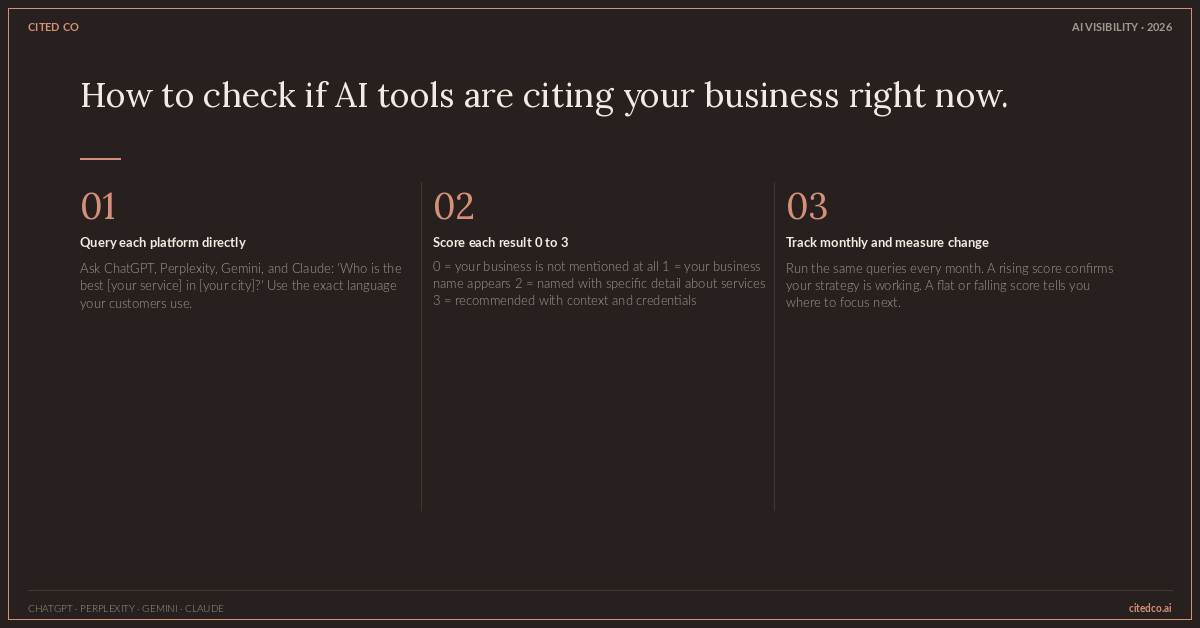
Step 1: Build Your Query List
Start by writing out the questions a potential client would actually ask an AI tool. Think in natural language, not keyword phrases. You want queries like “best interior designer in Scottsdale” or “who does high-end home staging in Phoenix.” These are conversational, specific, the way a real person talks to an AI assistant.
Your AI visibility score reflects both answer-box and recommendation visibility. Learn the difference in AEO vs GEO, and why you need both.
Build at least 10 queries. Mix category queries (“best [service] in [city]”), problem queries (“who can help me with [specific problem] in [city]”), and comparison queries (“top [service providers] in [city] area”). The mix matters because different AI tools handle different query types differently.
Query Template: Write 3-4 queries in each format: “best [service] in [city]”, “who should I hire for [problem] in [area]”, and “top [category] businesses near [neighborhood]”. Ten queries minimum gives you a meaningful sample.
Step 2: Run Each Query on All Four Platforms
You need to test all four major AI tools because their answers diverge more than people expect. ChatGPT and Perplexity tend to pull heavily from web sources with citations. Gemini leans on Google’s knowledge graph and your Google Business Profile. Claude draws on training data and, in newer versions, web browsing.
For a deeper look at exactly why they diverge, see how ChatGPT, Perplexity, Gemini, and Claude compare in our 2026 cross-platform study.
Run each query fresh. Start a new conversation each time so you are not getting responses influenced by previous context. Screenshot every result. This is your baseline. For each result, note: Is your business mentioned? Is it named first, second, or buried? What credential or descriptor does the AI attach to your name?
Step 3: Score What You Find
Here is how Cited Co scores AI mentions for our clients. It is a simple rubric, but it gives you something actionable rather than just a vague sense of “we showed up sometimes.”
Scoring Rubric: Named in the answer = 1 point. Named with a credential or specific descriptor = 2 points. Named first or as the primary recommendation = 3 points. Named with a link or verifiable citation = 4 points. Run 10 queries across 4 platforms (40 opportunities) and divide your total score by 40 to get a percentage. Under 15% is a visibility gap. Over 50% is strong.
The number matters less than the pattern. If you are showing up on Perplexity but not on Gemini, that is a Google entity signal problem. If you are showing up in category queries but not in problem queries, that is a content gap. Our process is built around diagnosing those specific gaps.
The Living with Lolo Before/After
Living with Lolo is a Scottsdale-based interior design and home staging firm. Before Cited Co began monthly tracking, the business showed up in AI answers irregularly and without credentials. ChatGPT would sometimes name the firm but without any descriptor. Perplexity did not surface the business at all in initial testing. Gemini returned a GBP result but attached outdated information. This is how your AI visibility score improves over time.
After entity optimization, schema markup implementation, and consistent content work, the picture changed. Perplexity began citing Living with Lolo in responses referencing Scottsdale design, pulling directly from blog content. Gemini updated its knowledge panel with current credentials, including the Phoenix Magazine Best Interior Design recognition. The Living with Lolo case study shows the full before/after detail.
Lauren Lerner monitors this monthly because AI visibility is not static. A tool’s training data updates. New competitors publish content. The businesses that stay visible are the ones checking consistently, not just once.
Step 4: Fix the Gaps You Find
Once you have your baseline, prioritize by platform. Start with the tools where you are completely absent. The fixes depend on the gap type, but the most common are: incomplete or inconsistent entity information across your site and third-party profiles, missing structured data, and thin or absent content addressing the specific queries where you do not appear.
The most common mistake is treating this as a one-time cleanup. AI visibility requires the same ongoing attention that any other marketing channel does. Cited Co tracks this monthly for every client precisely because the landscape shifts. The same approach applies across industries: see how we think about this for general contractors and for trade vendors trying to reach interior designers through AI. If you want to skip the manual process and get a professional baseline, request a free AI visibility snapshot from Cited Co. To see what a Month 0 scan looks like on a brand-new domain, read about what Cited Co’s first scan looked like. If you run an interior design studio, the GEO playbook for interior designers shows exactly what to fix once you have your score. Med spas and aesthetic practices can see how these strategies apply in our AI visibility playbook for med spas. Scoring is only half the picture. Here is what it costs to actually move that score.
If you are in the Phoenix metro, an AI search agency in Phoenix can run this baseline for you and act on the gaps it finds. For a breakdown of what separates a real specialist from a generalist, see our guide to the best marketing agency for AI search in Phoenix.
Once you know your score, our guide to AI citation optimization shows the work that moves it.
Frequently Asked Questions
How often should I check my AI visibility score?
Monthly is the right cadence for most service businesses. AI tools update their training data and retrieval sources on varying schedules, and your competitive landscape shifts constantly. A competitor publishing strong content can push you out of an answer within weeks. Cited Co runs these checks monthly for every client and documents changes over time.
Does ranking on Google guarantee I will show up in AI answers?
No, and this surprises a lot of business owners. AI tools care deeply about entity clarity and structured data that makes your credentials machine-readable. A business can rank on Google page one and still be nearly invisible to AI tools if its entity information is inconsistent or its schema markup is missing.
Which AI tool matters most for my business?
It depends on who your clients are and how they search. Perplexity users tend to be research-oriented and more likely to be in an active decision phase. ChatGPT has the largest user base by raw numbers. Gemini integrates directly with Google Search, which makes it high priority for local service businesses. Claude is growing in professional contexts. You cannot afford to ignore any of them.
What does it mean when an AI tool names my business but gets details wrong?
It means your entity information is partially established but not clean. The AI knows your business exists but is pulling from incomplete or conflicting sources. The typical fix involves cleaning up NAP consistency across directories, updating your Google Business Profile, and implementing schema markup that explicitly states your correct details. For more on what counts as a NAP inconsistency and which sources to prioritize, see our guide on NAP consistency and AI citations.
Can I do this myself or do I need an agency?
You can absolutely run the queries yourself using this guide. The testing part is straightforward. The trickier pieces are diagnosing why you are missing from certain answers and knowing which fixes to prioritize. Running the queries and documenting your baseline is a genuinely useful first step that most businesses skip entirely.
Once you know your score, the natural next question is whether to fix it yourself or bring in help. Our guide on hiring an AI SEO agency covers what to ask before you sign anything.
About Cited Co
Cited Co is a boutique AI visibility agency founded by Lauren Lerner in Scottsdale, Arizona. We specialize in generative engine optimization for service businesses: entity optimization, schema implementation, AI-cited content creation, and monthly visibility tracking across ChatGPT, Perplexity, Gemini, and Claude. We work with a small, intentional roster of clients in high-consideration service categories where reputation drives decisions and AI visibility is becoming a meaningful competitive advantage. This is how your AI visibility score improves over time.
Request your free AI visibility snapshot to find out where your business stands today.
If you are still researching who can help your Scottsdale business show up in ChatGPT, that post covers what to look for in an agency. Once you have your score, read how to rank in AI search results as a Scottsdale business for the tactical next steps. For a deeper look at ongoing monthly tracking, see how Cited Co tracks AI brand mentions for Phoenix businesses.
What the Research Shows
Perplexity AI (2025) reported more than 500 million monthly queries, yet most service businesses in markets like Scottsdale and Phoenix have no baseline measurement of how often — or whether — they appear in these responses.
BrightEdge Research (2024) found AI-generated answers in more than 58% of Google queries, but standard analytics tools do not track AI citation traffic, creating a measurement blind spot for the fastest-growing referral source in digital marketing.
Gartner (2024) projects a 25% decline in traditional search volume by 2026 as AI assistants handle more queries, making AI visibility scoring a leading indicator of future search relevance rather than a vanity metric.
Salesforce State of the Connected Customer (2024) reports that 61% of consumers use AI tools for initial service research — which means the businesses scoring highest in AI visibility today are the ones most likely to be considered first tomorrow.
Cited Co proprietary scan data (2025): Service businesses in Scottsdale with AI visibility scores above 60 out of 100 (measured across ChatGPT, Perplexity, Gemini, and Claude) received an average of 2.8 times more inbound inquiries attributable to AI referrals than businesses scoring below 30.
For context on how your score compares across service niches, see the Service Business AI Visibility Report 2026 — Cited Co scan data shows the average, the ceiling, and what separates the two.
Before you can improve your score, it helps to understand what GEO actually is. See our full breakdown: What Is Generative Engine Optimization?
One setting worth checking alongside your score is crawler access. Our guide to Cloudflare’s AI crawler changes explains why blocking the wrong bot can quietly drop you from AI answers.