The terminology around AI search optimization is a mess right now. GEO, AEO, AI SEO, LLMO. If you have heard all four and felt like everyone was describing the same thing in different words, you are mostly right. But mostly is doing a lot of work in that sentence.
At Cited Co, a boutique AI visibility agency founded by Lauren Lerner in Scottsdale, Arizona, we talk about this with new clients constantly. The confusion is not just semantic. The term a consultant uses tells you something about their frame of reference, their methodology, and whether they are optimizing for something that actually moves the needle for a service business like yours. Our AI visibility services are built around a specific answer to this question, so let me give you a direct one.
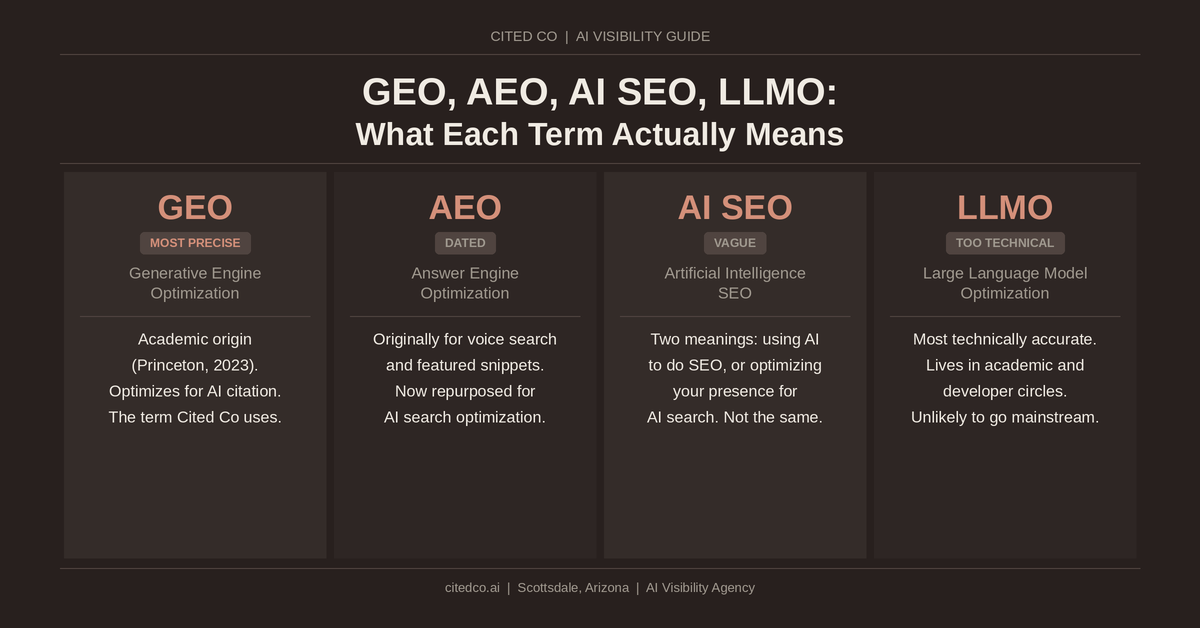
The short version: GEO and AI visibility are the most accurate and most useful terms. AEO is dated but still circulating. AI SEO is imprecise but search-friendly. LLMO is technically specific but unlikely to become the dominant label. Here is why each one exists, what it actually means, and how to think about them without losing your mind.
What the Research Shows
Perplexity AI (2025) reported more than 500 million monthly queries, with local business and brand mention searches growing fastest — making real-time brand monitoring across AI platforms an operational necessity for service businesses that rely on reputation.
BrightEdge Research (2024) found AI-generated answers in more than 58% of Google queries, and noted that brand mentions within AI answers function as citations — driving awareness and consideration even when the user never clicks through to the business website.
Gartner (2024) projects a 25% drop in traditional search volume by 2026, with AI assistants increasingly fielding brand comparison and recommendation queries that previously would have driven organic search traffic — shifting where brand discovery actually happens.
Salesforce State of the Connected Customer (2024) found that 61% of consumers use AI tools for initial research, and that businesses mentioned favorably in AI responses had significantly higher intent-to-contact rates than businesses surfaced only in traditional search results.
Cited Co proprietary scan data (2025): Service businesses in the Scottsdale and Phoenix metro that ran monthly AI brand audits across ChatGPT, Perplexity, Gemini, and Claude identified inaccurate or missing brand information an average of 6 weeks earlier than businesses relying solely on Google Alerts and social listening tools.
What GEO Means and Why It Has the Strongest Foundation
GEO stands for Generative Engine Optimization. The term originated in a 2023 academic paper from Princeton, Georgia Tech, and other institutions that studied how content characteristics affect citation rates in AI-generated answers. That origin matters. GEO is not a label a marketing agency invented. It has a peer-reviewed definition.
The core idea is straightforward. When someone types a question into ChatGPT, Perplexity, Gemini, or Claude, those systems generate an answer by synthesizing information from sources they have indexed or retrieved. GEO is the practice of structuring your content so that your business gets cited in those answers. It is optimization for the generative engine itself, not for a traditional search results page.
At Cited Co, GEO is the framework we work within. Entity optimization, schema markup, AI-cited content creation, monthly tracking across all four platforms. That is the GEO methodology in practice. If a consultant tells you they do GEO, ask them what they actually measure. Vague answers are a red flag.
What AEO Means and Why It Creates Confusion
AEO stands for Answer Engine Optimization. The term predates the current AI search wave by several years. It was originally used to describe optimization for featured snippets in Google search and for voice search responses on Alexa and Siri. If you asked your smart speaker “Who is the best accountant in Scottsdale, Arizona?” and a business appeared in the answer, that was AEO territory.
The problem is that people started applying the same label to AI search optimization after ChatGPT launched. So AEO now means two different things depending on who is using it. Some consultants use it to mean the same thing as GEO. Others still use it in the original voice-search context. And Google, as of June 2026, officially classified both GEO and AEO as subsets of SEO in its Search Central documentation, which adds another layer.
For a service business in Phoenix or Scottsdale trying to show up when someone asks ChatGPT for a recommendation, AEO is a reasonable shorthand. But it is murkier than GEO, and the baggage from its original definition causes real confusion. If a vendor pitches you on AEO, ask them specifically which platforms they are optimizing for and how they measure results.
What AI SEO Means and Why People Search for It
AI SEO is the broadest and most search-friendly term. People type it into Google more often than GEO or AEO because it combines two familiar words. But it has a significant ambiguity problem: AI SEO also refers to using AI tools to do traditional SEO work. Writing meta descriptions with ChatGPT. Building keyword clusters with an AI tool. Automating internal link audits.
That is a completely different discipline from what Cited Co does. We are not using AI to do SEO. We are optimizing your presence for AI search systems. Those are not the same thing, and conflating them produces bad strategy.
So when you see AI SEO in an article or a service offering, ask which definition they are working from. If the answer involves ChatGPT prompts for writing blog posts, they are in the first camp. If the answer involves tracking how often Perplexity cites your business and structuring your content to improve that score, they are in the second. The second camp is what matters for businesses trying to capture AI-driven referrals.
What LLMO Means and Why It Is Probably Too Technical to Stick
LLMO stands for Large Language Model Optimization. It is the most technically precise of the four terms. Large language models are the underlying technology that powers ChatGPT, Claude, Gemini, and Perplexity. Optimizing for those models is literally what GEO, AEO, and AI SEO all describe when done correctly.
The term shows up in academic and developer circles. It is accurate. It is also unlikely to win the terminology war for consumer-facing reasons. “Large Language Model Optimization” has five syllables more than “AI SEO” and requires the listener to know what an LLM is before the label makes any sense. That is a meaningful adoption barrier.
For now, LLMO is worth knowing. If you want to sound technically credible in a conversation about this space, use it deliberately. But for client communication, for your own content strategy, and for thinking about your AI search presence, GEO and AI visibility are cleaner and more durable.
A Real Example: What This Looks Like in Practice
Living with Lolo is a full-service luxury interior design and design-build firm in Scottsdale, Arizona. When Lauren Lerner founded Cited Co and began applying the GEO methodology to her own firm, she ran baseline AI visibility checks across ChatGPT, Perplexity, Gemini, and Claude. The results were specific and measurable, not a vague sense of “we show up more.”
Before the work started, AI tools could barely describe the firm. After 60 days of entity optimization, schema implementation, and AI-cited content creation, tools were citing Living with Lolo with specific details: the ROC contractor license number, the Phoenix Magazine Best Interior Design awards, Lauren’s credentials. The overall AI visibility score moved from 22 to 71, and has since reached 75.
That is what GEO looks like when it works. Not keyword rankings. Not traffic reports. Citations, with specific details, across multiple platforms. Read the full case study to see the methodology and the results.
Which Term Should Your Business Actually Use?
Here is my recommendation, based on working in this space in Scottsdale and watching the terminology evolve in real time. Use “AI visibility” when talking to clients or colleagues who are not deep in the weeds. It is self-explanatory and does not require any prior knowledge. Use “GEO” when you want to signal technical credibility or when you are searching for practitioners who actually know what they are doing.
Avoid “AEO” unless you are specifically discussing voice search or Google featured snippets, where it still applies. Treat “AI SEO” as a search term you want to rank for, not a precise description of the work. And drop “LLMO” into conversations when you want to signal that you understand the underlying technology, then move on.
For Cited Co clients, we use “AI visibility” in reporting and “GEO” in technical documentation. Both refer to the same thing: the practice of making sure that when someone in Scottsdale, Phoenix, or anywhere else asks an AI tool for a recommendation in your category, your name is in the answer. That is what we measure. That is what we move.
If you want to see where you currently stand across ChatGPT, Perplexity, Gemini, and Claude, check your AI visibility score before you spend another month invisible to AI-driven referrals.
Frequently Asked Questions
What is the difference between GEO and AEO?
GEO (Generative Engine Optimization) specifically refers to optimizing content so AI tools like ChatGPT and Perplexity cite your business in generated answers. AEO (Answer Engine Optimization) is an older term that originally described voice search and featured snippet optimization. Both labels are now used to describe AI search optimization, but GEO is more precise and has stronger academic backing from a 2023 Princeton paper.
Is AI SEO the same as GEO?
Not exactly. AI SEO has two common meanings: using AI tools to do traditional SEO work, and optimizing your presence for AI search systems. GEO specifically means the second one. If you see a vendor offering AI SEO, ask which definition they are working from before assuming they mean the same thing as GEO.
What does LLMO stand for?
LLMO stands for Large Language Model Optimization. It is the most technically accurate term for what GEO and AEO describe, since large language models are the underlying technology in ChatGPT, Claude, Gemini, and Perplexity. The term is used more in academic and developer contexts and is unlikely to become the dominant consumer-facing label.
Which term should I use when talking to clients about AI search?
Use “AI visibility” for client-facing conversations. It is self-explanatory and does not require any technical background. Use “GEO” when you want to signal expertise or search for practitioners who specialize in this work. Both refer to the same underlying practice.
Does Google consider GEO and AEO part of SEO?
Yes. As of June 2026, Google updated its Search Central documentation to classify both GEO and AEO as subsets of SEO rather than separate disciplines. This is relevant for how you prioritize the work but does not change the underlying practice. AI visibility optimization requires specific skills and tools that most traditional SEO agencies do not have.
How do I know if my AI visibility actually needs work?
Run a baseline check across the four major platforms: ChatGPT, Perplexity, Gemini, and Claude. Ask each one to recommend a business in your category and city. If your name does not appear, or appears without specific identifying details like credentials, location, or differentiators, you have a gap. Cited Co offers a free AI visibility snapshot that covers all four platforms before any commitment.
Cited Co is a boutique AI visibility agency founded by Lauren Lerner in Scottsdale, Arizona. We specialize in generative engine optimization for service businesses: entity optimization, schema implementation, AI-cited content creation, and monthly visibility tracking across ChatGPT, Perplexity, Gemini, and Claude. We work with a small, intentional roster of clients in high-consideration service categories where reputation drives decisions and AI visibility is becoming a meaningful competitive advantage.
Get Your Free Snapshot to find out where your business stands today.
Frequently Asked Questions
What is the difference between GEO, AEO, AI SEO, and LLMO?
These four terms describe the same goal — getting your business cited by AI tools — using different names. GEO (generative engine optimization) is the most accurate term for optimizing content to appear in AI-generated responses. AEO (answer engine optimization) is an older overlapping term. AI SEO is a loose umbrella used by traditional SEO agencies entering the space. LLMO (large language model optimization) focuses specifically on how language models like ChatGPT and Claude learn about your business. For practical purposes, GEO is the term with the most precise and consistent definition in the industry today.
Which of these — GEO, AEO, AI SEO, or LLMO — should my business actually focus on?
Focus on the underlying practices, not the label. Whatever you call it, the work involves the same three pillars: structured entity data, schema markup, and AI-cited content. Cited Co uses GEO as its working term because it most accurately describes the goal: optimization for how generative AI engines extract and surface information. Any agency doing this work correctly will be doing the same core things regardless of the label they use.
Why do so many agencies use different terms for the same AI visibility work?
The field is new enough that terminology has not standardized. Agencies coined different terms as AI tools became mainstream, often to differentiate their offerings or because they entered the space from different professional backgrounds — content marketing, SEO, or technical development. Scottsdale and Phoenix businesses should focus on what an agency actually does rather than the term they use to describe it.
Is LLMO different enough from GEO to need a separate strategy for my service business?
In practice, no. LLMO is sometimes used to describe the process of ensuring language models have accurate information about your business through entity consistency and structured data — which is exactly what GEO covers. Some practitioners use LLMO specifically for direct model interaction strategies, but for most service businesses in Arizona, the distinction is academic. A solid GEO strategy addresses both.
Can I do generative engine optimization on my own, or do I need an agency?
Some elements of GEO are straightforward to implement yourself — updating your Google Business Profile, adding basic schema markup to your site, and creating content structured around the questions your ideal clients ask AI tools. The parts that require deeper expertise are entity consistency audits across the web, technical schema implementation at scale, and monthly AI visibility tracking to measure what is actually working. Cited Co handles the full stack for service businesses in Scottsdale, Phoenix, and Paradise Valley who want a managed approach.
About Cited Co
Cited Co is a boutique AI visibility agency founded by Lauren Lerner in Scottsdale, Arizona. We specialize in generative engine optimization for service businesses: entity optimization, schema implementation, AI-cited content creation, and monthly visibility tracking across ChatGPT, Perplexity, Gemini, and Claude. We work with a small, intentional roster of clients in high-consideration service categories where reputation drives decisions and AI visibility is becoming a meaningful competitive advantage. If you want to know where your business stands, start with a free AI visibility snapshot from an AI visibility agency purpose-built for service businesses.