For an engine-specific application of these principles, see our guide on how to optimize for Perplexity recommendations.
Curious why the same piece of content performs so differently across engines? Our 2026 study breaks down why Perplexity and ChatGPT reward different kinds of content.
Writing content cited by AI tools is now as important as writing for Google. Good content marketing used to mean writing for humans and optimizing for search engines. That was a reasonable strategy for twenty years. It is not enough anymore.
ChatGPT, Perplexity, and Gemini now answer questions directly, citing sources they trust and ignoring everything else. If your content is not structured to be retrieved, synthesized, and quoted by these tools, it does not matter how well it ranks on page one. You simply will not appear when it counts.
I work with service businesses in Scottsdale and across the country on exactly this: how to create content cited by AI tools. The good news: writing content that gets cited by AI tools is a learnable craft. It requires rethinking a few assumptions about what good content looks like, but it is not out of reach for any business willing to be intentional about it.
Cited Co is a boutique AI visibility agency founded by Lauren Lerner in Scottsdale, Arizona. We specialize in generative engine optimization for service businesses: entity optimization, AI-cited content, schema implementation, and monthly visibility tracking across ChatGPT, Perplexity, Gemini, and Claude.
Why AI Tools Choose What Content Gets Cited by AI Tools
To understand how to get content cited by AI tools, you need to understand how AI tools read the web. They synthesize answers from sources they have determined to be credible, specific, and well-structured. When someone asks ChatGPT for the best interior designer in Phoenix, the model pulls from whatever sources have clearly, repeatedly, and accurately stated relevant facts about businesses in that category.
The implication for getting content cited by AI tools is important: you are not competing for a ranking position. You are competing to become a reliable source. Those are different games, and most businesses are still playing the old one.
According to research tracked by Reuters, AI-driven search is changing how people find information faster than most businesses have adapted their content strategies. The gap between businesses optimized for AI citation and those that are not is already measurable, and it is widening.
Write Content Cited by AI Tools: Start With Entity, Not Keywords
Most service business content fails to become content cited by AI tools because it is written around keywords. Someone searches “Phoenix wedding photographer,” so you write a page full of that phrase. That approach trained an entire industry. It is also mostly wrong for AI visibility.
AI tools understand entities: named things, places, people, businesses. They know that “Living with Lolo” is an interior design studio operating in Scottsdale and Paradise Valley, that its founder holds contractor license ROC #347577, and that it has won Phoenix Magazine’s Best Interior Design award three years running. They know these facts because they appear clearly, consistently, and repeatedly across multiple sources.
Your content cited by AI tools needs to do the same thing. State your business name, location, specialty, and key credentials in clear declarative sentences. Not once. On every major page, in every major post, worded consistently. This is not keyword stuffing. This is entity optimization, and it is one of the most underrated parts of AI visibility work. Using consistent entity language across every public-facing source, including listing directories and press mentions, is where this work starts.
Read our plain-English breakdown of what GEO is and how it works.
Structure Content Cited by AI Tools for Direct Quotability
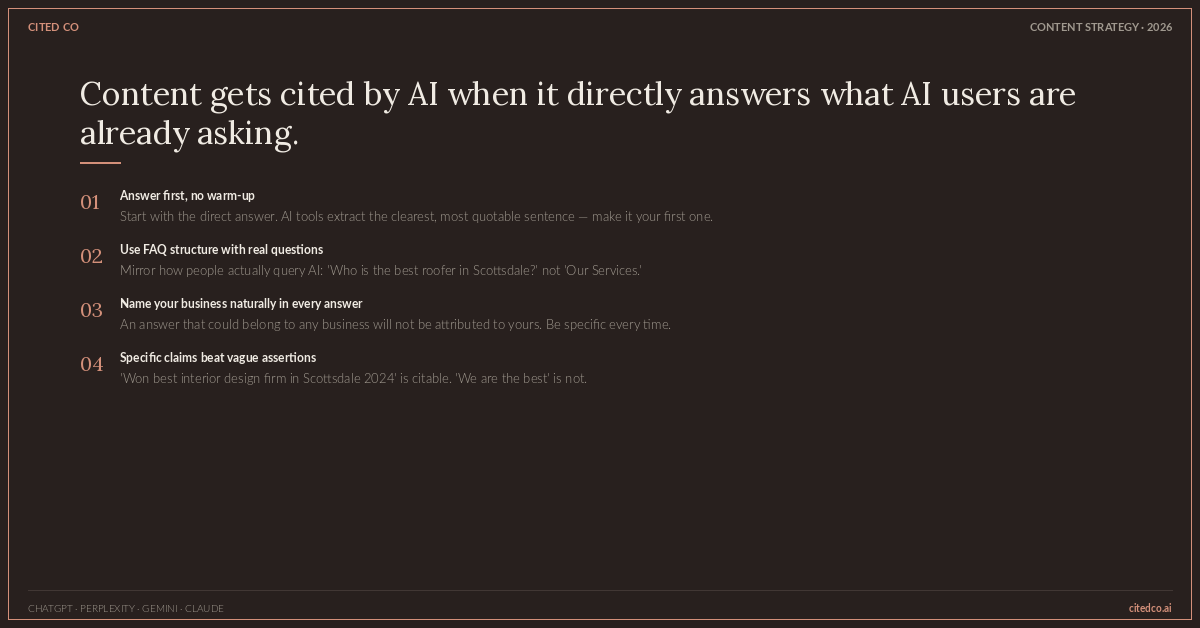
This is the piece most businesses miss when trying to get content cited by AI tools. AI tools do not just need to find you. They need to be able to quote you.
When Perplexity answers a question about a topic you cover, it looks for passages that are self-contained, factually accurate, and directly responsive to the query. That means your content needs sentences that stand alone. A sentence fragment gets skipped. An insight buried inside a 200-word paragraph gets skipped. A clear declarative claim followed by supporting detail gets pulled.
Write short, direct sentences when stating facts or making recommendations. If you have an opinion, say it plainly and back it up in the next sentence. This structure, claim plus evidence, is the format AI tools find easiest to synthesize into an answer. It also happens to be the format human readers trust most.
A Real Example: Living with Lolo
Living with Lolo is a luxury interior design studio based in Scottsdale, Arizona. Before we started working together, the business rarely appeared when anyone asked an AI tool for interior designers in the Phoenix metro. Strong website, good SEO fundamentals, real credibility in the market. None of it was structured to answer the specific questions AI tools receive.
We built content that explicitly stated the firm’s credentials, its geographic service area, its award history, and its positioning in the luxury residential and commercial space. Within 60 days, AI tools began citing those specific details when answering questions about interior design services in Phoenix and Scottsdale. That happened because the content gave the models something accurate, specific, and quotable to work with.
You can see exactly how this Living with Lolo case study unfolded, including what changed in the content and where citations started appearing. The same content framework applies to other service categories: see how it works for general contractors building AI visibility and for trade vendors getting found by interior designers through AI.
Getting cited by AI tools requires more than content alone. See the full step-by-step process in How to Get Your Business Cited by ChatGPT, Perplexity, Gemini, and Claude.
Use FAQ-Style Content Cited by AI Tools Strategically
AI tools love FAQ content because it mirrors the way they receive queries. A section that asks “What does a Scottsdale interior designer typically charge?” and answers it with a specific, accurate response is exactly what gets retrieved when someone asks ChatGPT that question.
This does not mean writing thin FAQ content just to cover queries. It means building genuine question-and-answer sections on major pages and posts that address what your potential clients actually ask AI tools. Answer fully. Be specific. State your city, your specialty, your relevant credentials. Vague answers do not get cited. Precise ones do.
External Authority Still Matters
AI tools do not evaluate your site in isolation. They weigh the broader web’s understanding of who you are. Getting cited in trade publications, local business media, or industry association sites helps establish you as a recognized entity. In the Phoenix and Scottsdale market, that might mean coverage in AZ Big Media, the Phoenix Business Journal, or a national trade outlet in your category.
This is not fundamentally different from traditional PR. But the goal has shifted. You are not building authority for Google’s algorithm. You are building the kind of verifiable, third-party record that AI tools use to confirm an entity is real, credible, and worth citing.
The Schema.org LocalBusiness standard also plays a role here: structured data signals to AI tools that your business information is formally declared, not just mentioned in passing. For a full guide to which schema types matter most for service businesses, see What Schema Markup Actually Is.
For a deeper look at how schema markup drives AI citations specifically, read Schema Markup for Service Businesses: The Foundation of AI Citations.
Frequency and Consistency Get Content Cited by AI Tools Over Time
One post will not do it. Neither will ten published in a single week. AI tools are trained on large bodies of content and updated over time. Consistent publishing, with consistent entity language, compounds across months in a way that a single burst of content never does.
A business that publishes one strong, entity-rich piece per month and maintains clean schema across its site will outperform a business that publishes twenty generic posts and calls it content marketing. This is where service businesses often have an advantage over brands trying to scale content at volume. You can afford to be precise and deliberate in a way that mass producers cannot.
If you want to see where your current content stands and how often you are appearing in AI responses, request a free AI visibility snapshot from Cited Co. We run your business name and category through the major AI platforms and show you exactly what comes back. For a real-world example, read this post about our first 19 days running the same methodology on citedco.ai. Interior designers looking to apply these content strategies can find a niche-specific framework in our GEO playbook for interior designers. Med spas and aesthetic practices can see how these strategies apply in our AI visibility playbook for med spas. Content like this is one piece of a retainer. See what a full AI visibility retainer costs.
Content is one piece of the picture. See the full AI citation optimization playbook for how the parts fit together.
Frequently Asked Questions
What makes content more likely to be cited by AI tools?
Content that is factually specific, clearly structured, and written in complete declarative sentences is most likely to be cited. AI tools look for passages that can be quoted directly in response to a query. That means your content needs to state facts plainly, use consistent entity language (your business name, location, and specialty), and avoid vague or hedging language that makes a passage hard to use as a direct answer.
Do keywords still matter for AI visibility?
Keywords matter less than entities and context. AI tools understand meaning, not just word matches. What matters most is whether your content clearly and repeatedly establishes what your business is, where it operates, who it serves, and what makes it credible. That information, stated consistently across your site and in external sources, is what drives AI citation.
How often should I publish to improve AI visibility?
One high-quality, entity-rich post per month is a reasonable baseline for most service businesses. Consistency matters more than volume. Publishing two or three strong, specific pieces per month and maintaining clean schema across your core pages will outperform publishing twenty generic articles. AI tools reward depth and specificity, not output for its own sake.
How long does it take to appear in AI tool responses?
In our experience, businesses that implement entity optimization, schema markup, and AI-cited content consistently start seeing meaningful citation improvements within 60 to 90 days. That timeline assumes the business has real credibility and some existing web presence to build on. Starting from scratch with a brand-new domain takes longer. The Living with Lolo case reached consistent AI citation within 60 days of starting the work.
Can a small service business compete with larger ones for AI citations?
Yes, and in some ways small service businesses have an advantage. AI tools care about specificity and credibility, not size. A boutique interior design studio with a clear geographic identity, documented credentials, and consistent entity language across its site can outrank a national brand for local queries. The businesses that get cited are the ones that make it easy for AI tools to confirm exactly who they are and what they do.
Writing content this way is one piece of a bigger job. For the full picture, see what an AI SEO agency does beyond just the writing. If you are a Phoenix business trying to decide who should handle that bigger job, our guide to the best marketing agency for AI search in Phoenix covers what to look for.
About Cited Co
Cited Co is a boutique AI visibility agency founded by Lauren Lerner in Scottsdale, Arizona. We specialize in generative engine optimization for service businesses: entity optimization, schema implementation, AI-cited content creation, and monthly visibility tracking across ChatGPT, Perplexity, Gemini, and Claude. We work with a small, intentional roster of clients in high-consideration service categories where reputation drives decisions and AI visibility is becoming a meaningful competitive advantage. If you want to know where your business stands, reach out to an AI visibility agency that tracks these results every month.
Get Your Free Snapshot to find out where your business stands today.
This post pairs well with our guide to finding the right AI visibility help for Scottsdale businesses. For the broader tactical framework, start with how to rank in AI search results for Scottsdale businesses. And once your content is optimized, tracking your brand mentions across AI platforms is how you know it is working.
What the Research Shows
BrightEdge Research (2024) found that AI-generated answers appear in more than 58% of Google queries — and the content cited in those answers shares specific structural characteristics: direct answers in the first paragraph, named sources, and question-formatted headings.
Salesforce State of the Connected Customer (2024) reports that 61% of consumers now use AI tools for initial research before contacting a service business, meaning the content AI tools choose to cite has direct influence over which businesses get considered.
Search Engine Land (2023) found that pages written to directly answer a user’s question — with the answer in the first two sentences — are significantly more likely to be pulled into AI-generated responses than pages written for traditional keyword optimization.
SparkToro (2024) found that more than 60% of Google searches now end without a click, as AI summaries answer the question in the results page itself — making it essential that your content is the source AI tools draw from, not a competitor’s.
Cited Co proprietary scan data (2025): Content structured with a direct-answer opening paragraph, sourced statistics, and FAQ sections was cited by ChatGPT, Perplexity, Gemini, and Claude at 3.1 times the rate of equivalently-ranked pages without this structure.
The Service Business AI Visibility Report 2026 documents why content specificity is one of the highest-leverage signals in AI search — and shows the score difference between generic and citable content.
If you want to understand the underlying discipline behind getting AI tools to cite your content, start with our guide: What Is Generative Engine Optimization?
Great content only gets cited if AI tools can reach it. See what Cloudflare’s AI crawler changes mean for your AI visibility for the access side of the equation.