What the Research Shows
Google itself confirmed in 2024 that generative engine optimization practices align with its core quality guidelines — meaning businesses that invest in GEO are building for both traditional and AI search simultaneously.
BrightEdge Research (2024) found that AI-generated answers appear in more than 58% of Google queries, with structured data and entity signals being the clearest predictor of which businesses get cited.
Gartner (2024) projects a 25% drop in traditional search volume by 2026 as AI assistants handle more queries — a shift Google is acknowledging with its own AI Overviews rollout across Search.
Search Engine Land (2023) found that pages with schema markup receive up to 30% higher click-through rates, and Cited Co scan data shows that schema-optimized pages are cited by AI tools at twice the rate of those without it.
Salesforce (2024) reports that 61% of consumers already prefer AI-generated answers for initial service research — which is exactly the behavior Google is building its search product to address.
What should a Scottsdale or Phoenix service business prioritize to start appearing in AI recommendations?
The proof is in results, not theory. The Living with Lolo case study documents exactly how Cited Co applied GEO principles to a Scottsdale-based home design business and moved the needle on AI citation frequency across ChatGPT, Perplexity, Gemini, and Claude.
Start with the fundamentals that Google and AI tools both respond to: consistent NAP data across all directories, a well-structured Google Business Profile with accurate categories and services, and LocalBusiness schema on your website. From there, generative engine optimization adds layers that traditional SEO does not: FAQPage schema tuned to conversational queries, entity optimization to build a clear business identity across the web, and content written specifically for AI extraction. Cited Co handles this full stack for service businesses in Scottsdale and the Phoenix metro area.
Google updated its Search Central documentation on June 5, 2026 with GEO AEO still SEO guidance to address how websites should optimize for generative AI features in Search. Buried in that update was a direct statement that the industry has been debating for two years: from Google’s perspective, optimizing for generative AI is “still SEO.” Cited Co founder Lauren Lerner runs an AI visibility agency in Scottsdale, Arizona that tracks AI citation results for service businesses across ChatGPT, Perplexity, Gemini, and Claude. This post breaks down what Google said, what it means for service businesses trying to appear in AI answers, and what it does not cover.
For a full breakdown of the four terms in circulation (GEO, AEO, AI SEO, and LLMO), see our comparison: GEO vs. AEO vs. AI SEO vs. LLMO: What Is the Difference?
What Google Actually Said About GEO AEO Still SEO
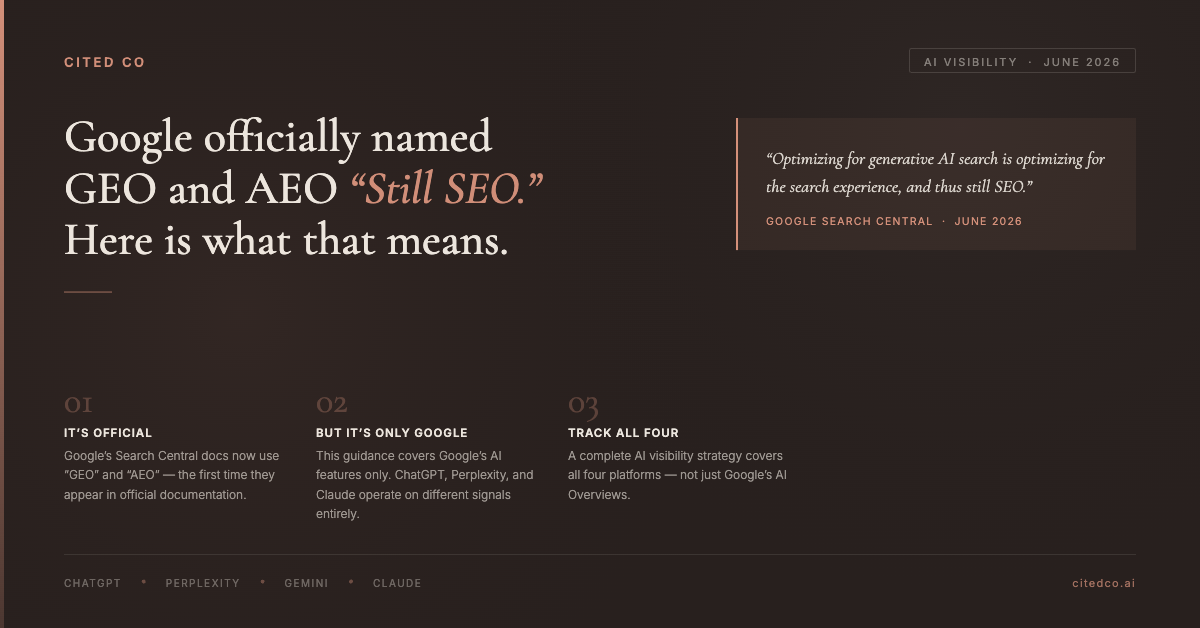
The new documentation page, titled “Optimizing your website for generative AI features on Google Search,” is the most direct guidance Google has published on this topic. On whether GEO (generative engine optimization) and AEO (answer engine optimization) represent new disciplines, Google stated:
“From Google Search’s perspective, optimizing for generative AI search is optimizing for the search experience, and thus still SEO.”
Google’s AI features are built on its core ranking and quality systems. The same signals that determine whether your business shows up in a standard Google search, your content quality, your entity clarity, your credibility signals, also influence whether you appear in AI Overviews and AI Mode. This is not a surprising technical position. It is, however, the first time Google has put it in official documentation.
For service businesses that have been hearing about GEO from agencies and wondering whether it is legitimate, this is a meaningful signal. The term is no longer industry jargon. It now appears in Google’s own vocabulary, in writing, at search.google.com.
Why This Is Useful When Talking to Skeptical Clients
One of the most common objections service business owners raise is some version of: “Is this GEO thing real, or is it a marketing buzzword?”
That objection about GEO AEO still SEO is now harder to sustain. When a client asks whether AI visibility optimization is a real category, you can point them to Google’s own documentation. Not a blog post. Not a conference presentation. The actual published documentation from the company that processes more search queries than any other platform on earth.
This also matters for service businesses that have been waiting to see whether AI visibility investment would hold up over time. The category is not going away. Google has described it in its own terms, tied it to core SEO fundamentals, and published guidance on what to prioritize. That is about as close to institutional validation as a category gets.
GEO AEO Still SEO: The Part That Matters Most
Here is where most industry coverage will miss something important. Google’s documentation is specifically about optimizing for Google’s own AI features: AI Overviews and AI Mode. The guidance, the caveats, the mythbusting, all of it applies to how Google’s systems work.
ChatGPT, Perplexity, and Claude operate differently. They are not Google products. They use different retrieval methods, different ranking signals, and different approaches to deciding which businesses to name in a response.
Cited Co tracks GEO AEO still SEO performance across four platforms every month: ChatGPT, Perplexity, Gemini, and Claude. What Google says about its own AI features is directly relevant to Gemini results. It is not a complete picture for the other three. A service business that optimizes only for Google’s AI features and ignores the signals that influence ChatGPT and Perplexity citations is leaving real visibility on the table.
For a step-by-step guide to building that multi-platform presence, read How to Get Your Business Cited by ChatGPT, Perplexity, Gemini, and Claude.
GEO AEO still SEO applies to Google. This is not a reason to dismiss that guidance. It is a reason to treat it as one input in a multi-platform strategy rather than a complete answer.
What Google Says to Focus On
The documentation puts particular emphasis on what Google calls “non-commodity content,” material that provides genuine insight rather than rephrasing common knowledge. Google contrasts “7 Tips for First-Time Homebuyers” with a specific, documented example: “Why We Waived the Inspection and Saved Money: A Look Inside the Sewer Line.” The second piece earns citation because it reflects a real, documented experience. The first could have been written by anyone.
For service businesses, this translates directly. A med spa that publishes a detailed case study about a specific treatment outcome, documented with real credentials and named expertise, is building the kind of content that earns AI citations. A med spa that publishes “Top 5 Benefits of Botox” is not.
Google also confirmed, as part of the GEO AEO still SEO framework, that structured data remains valuable. For clients working with Cited Co, this reinforces the entity optimization work that forms the foundation of every engagement. Schema markup helps AI tools recognize and accurately describe your business. That clarity matters across all four platforms, not just Google. The case for schema is covered in more detail in our guide to schema markup for service businesses.
What GEO AEO Still SEO Guidance Does Not Change
Google’s guide includes a mythbusting section naming several tactics as unnecessary for Google Search AI features: llms.txt files, content chunking, and seeking inauthentic mentions. It also says special schema for AI specifically is not required.
A few things worth noting here. These caveats apply to Google Search. They do not necessarily apply to how ChatGPT and Perplexity weight signals. And the core work that drives AI visibility, clear entity data, authoritative content, consistent credentialing across the web, is exactly what Google says matters. The tactics Google is pushing back on were fringe recommendations that credible practitioners were already skeptical of.
Nothing in this GEO AEO still SEO guidance changes the Cited Co approach. Build a clear entity profile. Publish content that earns citations. Track results across all four platforms every month. View the full breakdown of our AI visibility services to see how each piece fits together.
Frequently Asked Questions
Does Google’s confirmation that GEO is “still SEO” mean I do not need a separate AI visibility strategy?
Not exactly. The GEO AEO still SEO statement means that optimizing for Google’s AI features does not require a separate framework from standard SEO. But most service businesses want to appear across ChatGPT, Perplexity, Gemini, and Claude, not just Google’s AI features. For multi-platform AI visibility, a strategy built around AI citation signals, entity optimization, and cross-platform tracking is still the right approach. Cited Co tracks all four platforms monthly for every client.
Will my existing SEO work automatically improve my AI visibility?
Foundational SEO work, high-quality content, clean site structure, accurate business information, creates real overlap with AI visibility. But AI citation also depends on signals that standard SEO does not address: entity clarity across platforms, structured data with founder and credentialing information, and content written to answer the specific questions AI tools are actually being asked. A strong Google ranking does not automatically translate to strong AI citation.
What does Google’s guidance mean for schema markup?
Google confirmed that structured data is not required for generative AI features in Google Search, but it continues to recommend schema markup as part of a complete SEO strategy. For AI visibility across ChatGPT, Perplexity, and Claude specifically, schema markup remains one of the most reliable entity signals available. Cited Co implements schema markup as part of every engagement because it helps every AI platform accurately understand and cite your business, not just Google.
How is Cited Co’s approach different from standard SEO?
Standard SEO tools measure Google rankings and backlink profiles. They do not measure whether your business is named in a ChatGPT, Perplexity, Gemini, or Claude response. Cited Co runs eight to ten targeted queries per client across all four platforms every month, scores visibility, and tracks movement month over month. The work is focused on AI citation, not search engine ranking. The two often overlap, but they are not the same measurement.
Should I stop investing in AI visibility work now that Google says GEO is just SEO?
No. Google’s statement applies to its own AI Overviews and AI Mode inside Google Search, not to ChatGPT, Perplexity, Gemini, or Claude. Those platforms use separate crawlers, separate ranking signals, and separate citation criteria. A service business that wants to show up across all four still needs dedicated AI visibility work. Standard SEO alone will not get you there.
About Cited Co
Cited Co is an AI visibility agency based in Scottsdale, Arizona, founded by Lauren Lerner. Cited Co helps service businesses appear in AI-generated answers from ChatGPT, Perplexity, Gemini, and Claude through entity optimization, GEO content strategy, and citation signal building. Cited Co tracks client AI visibility monthly across four platforms using a consistent scoring system.
Get Your Free AI Visibility Snapshot
Find out where your business stands across ChatGPT, Perplexity, Gemini, and Claude. Request a free AI visibility snapshot and see exactly how AI tools describe your business today.
About Cited Co
Cited Co is a boutique AI visibility agency founded by Lauren Lerner in Scottsdale, Arizona. We specialize in generative engine optimization for service businesses: entity optimization, schema implementation, AI-cited content creation, and monthly visibility tracking across ChatGPT, Perplexity, Gemini, and Claude. We work with a small, intentional roster of clients in high-consideration service categories where reputation drives decisions and AI visibility is becoming a meaningful competitive advantage.
Get Your Free Snapshot to find out where your business stands today.