AI Visibility
Published July 6, 2026 by Lauren Lerner
How to Optimize for Perplexity Recommendations in 2026
To optimize for Perplexity recommendations, three things matter most: get your pages indexed in Bing, publish dated pages that answer the exact questions your customers ask, and earn mentions on the third-party sites Perplexity already trusts. Perplexity is the AI platform most service businesses ignore, and it is the one where recommendations are easiest to influence. I watch this play out in our client scans every month at Cited Co. A business shows up reliably in ChatGPT, then vanishes the second a prospect asks Perplexity the same thing. Same business, same website, different engine and different rules.
Cited Co is a boutique AI visibility agency founded by Lauren Lerner in Scottsdale, Arizona. We run monthly visibility scans and generative engine optimization for service businesses, and our services are built around closing exactly this kind of gap. Below I cover why Perplexity behaves differently from ChatGPT, the five signals that actually earn citations, and how to check where you stand today.
What the Research Shows
The move toward AI answers is not a prediction anymore. It is measurable, and the numbers should shape where you spend your time.
- Gartner (2024) predicted that traditional search engine volume will drop 25 percent by 2026 as people move questions to AI chatbots and virtual agents.
- Perplexity AI (2025) handled 780 million queries in May 2025 and was growing more than 20 percent month over month, according to CEO Aravind Srinivas.
- BrightEdge research (2025) found that 34 percent of AI citations come from sources a brand can influence through PR and third-party coverage, not only its own website.
- A 2025 Digiday consumer report found that 56 percent of US consumers planned to use AI chatbots to compare options and find what they need.
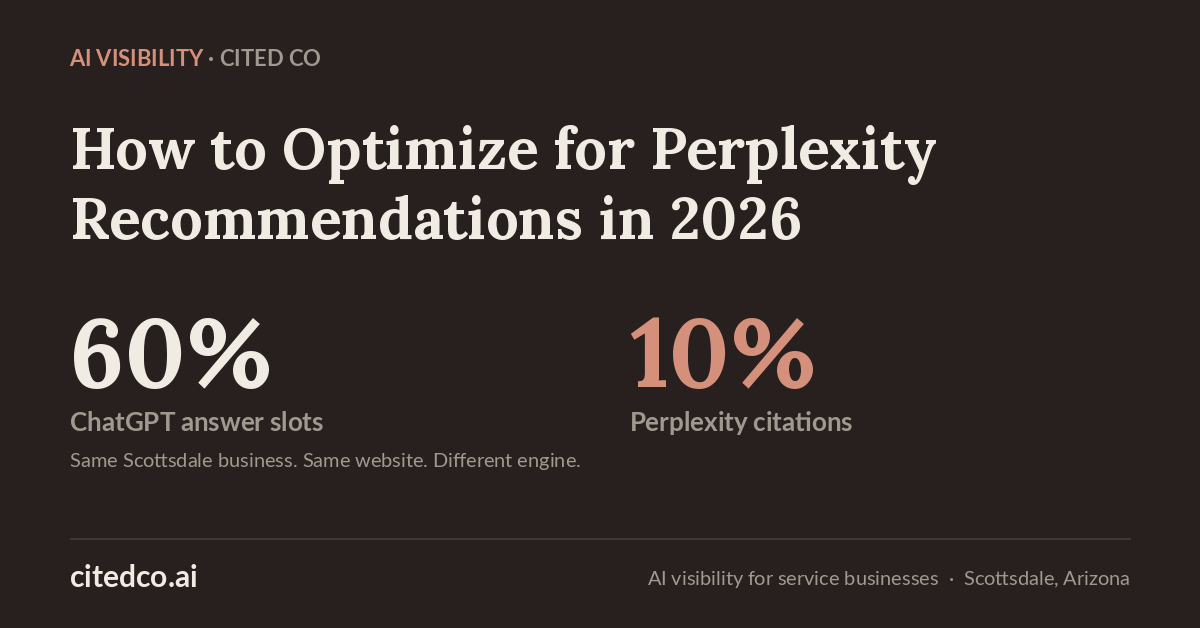
- Cited Co scan data (July 2026) shows one Scottsdale client appearing in 60 percent of ChatGPT answer slots but only 10 percent on Perplexity, a gap we see repeatedly across the Phoenix metro.
Read those together and the takeaway is simple. The audience is moving to AI answers quickly, and a large share of what those answers cite is within your control.
Why Perplexity Works Differently Than ChatGPT
Perplexity is a live retrieval engine. It searches the web at the moment of the question, reads what it finds, and writes an answer with citations pinned to specific pages. ChatGPT leans much harder on what the model already learned during training. That difference changes your job completely. It also means your wins compound, because a well-structured page keeps earning citations long after you publish it.
To influence ChatGPT, you shape the training-data footprint of your brand over months. To influence Perplexity, you need crawlable, current, well-structured pages that answer the exact question being asked, and you need them now. That is a faster game. In my opinion it is the highest-leverage work a local service business can do in 2026, and most owners have never heard it framed this way. If you want the bigger picture first, our primer on what generative engine optimization is lays out the whole model.
One thing most agencies miss: Perplexity’s retrieval leans heavily on Bing’s index. If your business is not in Bing Places and your pages are not indexed by Bing, you are invisible to Perplexity no matter how strong your content is. Check Bing first. It takes ten minutes, and it is the single most skipped step we see.
The Five Signals That Get You Cited by Perplexity in 2026
After running monthly scans across ChatGPT, Perplexity, Gemini, and Claude for our clients, here is what actually moves Perplexity citations, in order of impact.
One. A page that answers the exact question. Not a services page that mentions the topic. A dedicated page whose headline is close to the question a customer would ask. Perplexity quotes pages, not brands. Our guide to writing content cited by AI tools breaks down the structure we use.
Two. A visible, recent publish date. Perplexity strongly prefers fresh sources. A thorough page from 2023 loses to a decent page from last month. We refresh key client pages on an 18 month cycle at most, and we date everything.
Three. Bing indexation and a complete Bing Places listing. Covered above. Do it first, because nothing else works without it.
Four. Consistent citations across directories. When your name, address, and phone match on Google, Yelp, BBB, LinkedIn, and your own schema markup, retrieval engines treat you as a confirmed entity rather than a maybe. We wrote a full breakdown in our guide to schema markup for service businesses.
Five. Third-party mentions. Perplexity likes to cite lists, reviews, and press rather than a business talking about itself. One local magazine feature or a strong industry directory listing often does more than five self-published blog posts. We have watched a single Houzz feature move a client into Perplexity answers within a month.
A Real Example
Living with Lolo is a Scottsdale luxury interior design firm and our first client at Cited Co. When we started, the firm ranked well on Google Maps but barely registered in AI answers. Ask Perplexity for the best interior designers in Scottsdale and it built its answer from Houzz lists, Yelp pages, and local magazine roundups, none of which named the firm. For a three-time Phoenix Magazine Best Interior Design winner, that absence was quietly costing real referrals every month.
We fixed the retrieval and entity signals in the order above. Bing first, then dated question-shaped pages, then citation consistency across directories, then third-party mentions. Within about 60 days, all four platforms were citing the firm by name, license number, and award history. You can read the full breakdown in our case studies. As an AI visibility agency in Scottsdale, Arizona, we built and tested this process in our own Phoenix metro market before running it for anyone else.
How to Check Where You Stand Right Now
Open Perplexity in a logged-out browser window. Ask the three questions your best customers would ask, phrased the way real people phrase them. Note two things: whether you are named, and which sources Perplexity cites in the footnotes. Those cited sources are your roadmap. Write them down in the order Perplexity lists them, because that order tells you which gap to close first.
If it cites a Yelp list you are not on, get on it. If it cites a competitor’s cost guide, write a better one with a fresher date. For a scored version of this, our walkthrough on how to check your AI visibility score shows the exact method, and our services page shows what we run for clients every month.
Perplexity is only one of the four platforms that matter here. For the full picture across ChatGPT, Perplexity, Gemini, and Claude, see our breakdown of how to get cited by ChatGPT, Perplexity, and Gemini.
Frequently Asked Questions
How long does it take to show up in Perplexity results?
Faster than any other AI platform. Because Perplexity retrieves live, a well-structured page that Bing has indexed can start appearing in answers within a few weeks. ChatGPT visibility usually takes months longer. That speed is the main reason we tell service businesses to start with Perplexity.
Does Perplexity really use Bing instead of Google?
Perplexity uses its own crawler plus third-party search indexes, and Bing plays a significant role in that mix. In practice, businesses missing from Bing’s index consistently underperform in Perplexity citations. So treat Bing Places and Bing indexation as required, not optional.
Why do I show up in ChatGPT but not Perplexity?
ChatGPT answers draw heavily on training data, where an established brand has built up footprint over years. Perplexity rebuilds its answer from live retrieval every time. As a result, it rewards current, crawlable, directly relevant pages and third-party mentions instead of brand history.
What content works best for Perplexity citations?
Question-shaped pages with visible dates, clear headings, specific local details, and an FAQ section. Cost guides, comparison pages, and how-to content earn the most citations in our client data. The more directly a page answers one real question, the better it performs.
How do I get my Scottsdale service business recommended by Perplexity?
Start local and specific. Get listed and consistent in Bing Places, Google, and the directories Perplexity cites for your category, then publish a dated page that answers the exact question a Scottsdale customer would ask. Earn one or two third-party mentions, a local magazine feature or a reputable directory, and you give Perplexity a reason to name you. This is the core of what we do at Cited Co.
Can an agency guarantee Perplexity citations?
No, and you should be skeptical of anyone who promises one. What a good agency can do is measure your baseline, fix the retrieval and entity signals, publish the right content, and show you the citation rate moving month over month. If someone guarantees a specific placement, walk away.
Cited Co is a boutique AI visibility agency founded by Lauren Lerner in Scottsdale, Arizona. We specialize in generative engine optimization for service businesses: entity optimization, schema implementation, AI-cited content creation, and monthly visibility tracking across ChatGPT, Perplexity, Gemini, and Claude. We work with a small, intentional roster of clients in high-consideration service categories where reputation drives decisions and AI visibility is becoming a meaningful competitive advantage.
Get Your Free Snapshot to find out where your business stands today.